
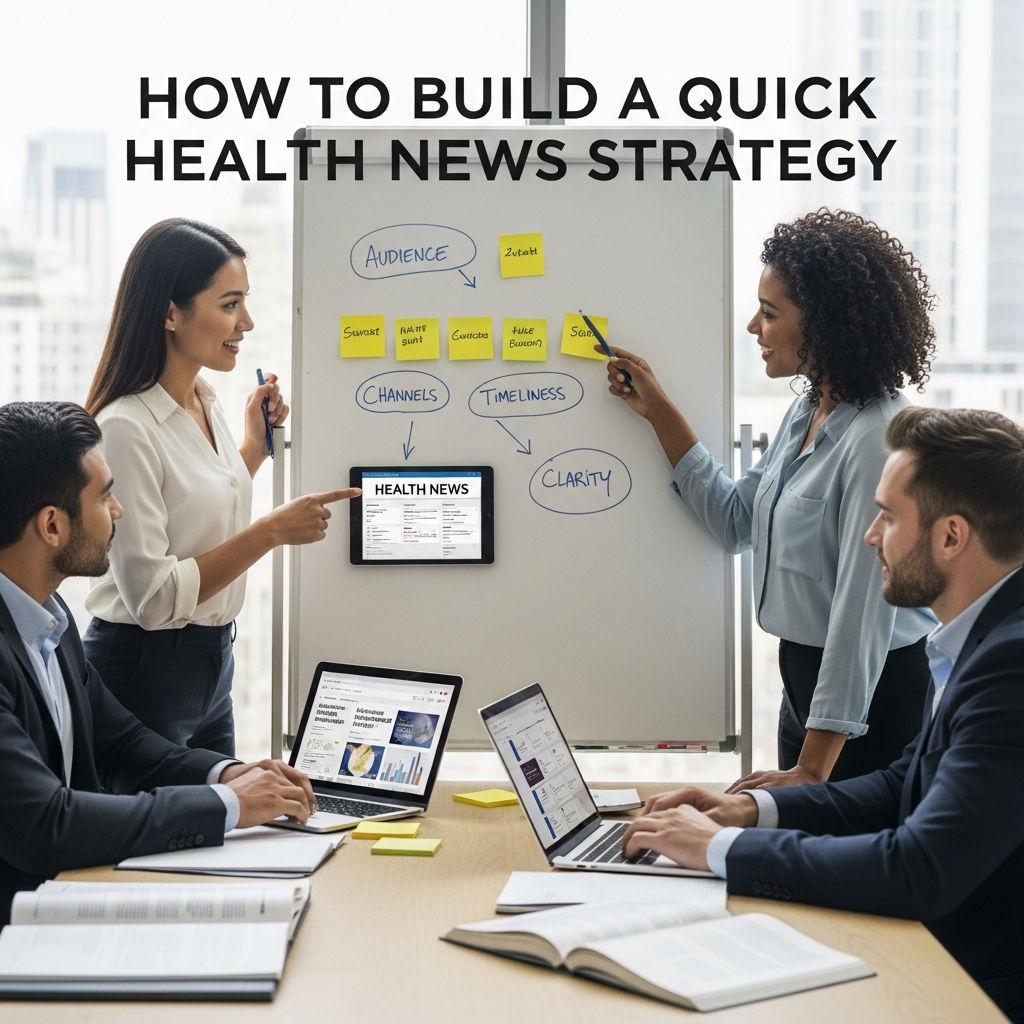
How to Build a Quick Health News Strategy: The Ultimate Guide for Fast, Reliable Content
In the digital age, health information moves at the speed of light. From a new FDA approval to a breakthrough study in a medical journal, the window for capturing “newsjacked” traffic is incredibly small. However, the health niche is unique. Unlike sports or entertainment, health content falls under Google’s YMYL (Your Money Your Life) category, meaning accuracy and authority are just as important as speed.
Building a quick health news strategy requires a delicate balance between being the first to report and being the most reliable source. If you sacrifice accuracy for speed, you risk losing your search rankings and your audience’s trust. If you move too slowly, the trend passes you by. Here is how you can build a streamlined, effective health news strategy that ranks.
1. Establish a High-Authority Sourcing Engine
The foundation of any “quick” strategy is knowing exactly where to look. You shouldn’t be searching Google for news; the news should be coming to you. To stay ahead, curate a list of primary sources that provide the raw data before mainstream media picks them up.
- Government Agencies: Bookmark the newsrooms of the CDC, FDA, NIH, and the WHO. These are the “gold standard” for authority.
- Medical Journals: Use platforms like PubMed, The Lancet, and The New England Journal of Medicine. Most journals offer press releases ahead of official publication.
- Press Release Hubs: Sites like EurekAlert! and Newswise allow you to filter by “Health” and “Medicine” to see what studies are being released to the media in real-time.
- Expert Networks: Follow leading doctors and researchers on X (formerly Twitter) and LinkedIn. Often, they provide context to new findings before they hit the headlines.
2. Implement Real-Time Monitoring Tools
To build a quick strategy, you need to automate your surveillance. You cannot manually check 50 websites every hour. Instead, use technology to alert you the moment a relevant keyword is mentioned.
Google Alerts is a basic starting point, but for a professional health news strategy, consider Feedly. By using RSS feeds from the sources mentioned above, you can create a single dashboard that aggregates every new health story. Another powerful tool is Talkwalker Alerts, which often picks up social media trends faster than Google. Set alerts for specific topics such as “heart health,” “weight loss medications,” or “mental health studies” to filter out the noise.
3. The “First But Accurate” Workflow
Speed is essential for Google News and “Top Stories” carousels. To move fast without compromising YMYL standards, adopt a “layered” reporting approach. You don’t need to write a 3,000-word deep dive immediately. Instead, follow this workflow:
- Phase 1: The Breaking Update (0-60 Minutes): Publish a 300-500 word post summarizing the facts. Who, what, when, and where. Include a direct link to the primary source (the study or the agency announcement).
- Phase 2: The Expert Context (2-4 Hours): Update the post with a “What this means for you” section. If possible, reach out to a medical professional for a quick quote to add original value.
- Phase 3: The Comprehensive Guide (24 Hours): Expand the article into a long-form piece that answers common questions, uses infographics, and provides historical context to the news.
4. Master SEO for Health News
Health news SEO differs from evergreen SEO. You are competing for Query Deserves Freshness (QDF) keywords. To win these, your technical SEO must be flawless.
Optimize Your Headlines for “News Intent”
In health news, users often search for specific terms like “Side effects of [Drug Name]” or “[Study Name] results.” Your H1 should be direct. Instead of a creative title like “A New Hope for Heart Patients,” use “FDA Approves New Treatment for Chronic Heart Failure: What Patients Need to Know.”
Use News Schema Markup
To help Google understand that your content is news, you must implement NewsArticle schema. This increases your chances of appearing in the Google News tab and the “Top Stories” section of the search results page. Ensure your “Date Published” and “Date Modified” timestamps are clearly visible to both users and bots.

Internal Linking and E-E-A-T
Every news story should link back to your evergreen pillar pages. If you are reporting on a new diet study, link to your comprehensive guide on nutrition. This passes authority and keeps readers on your site. Furthermore, ensure every health news piece has a clear author byline with credentials (e.g., “Written by [Name], Medical Review by [Doctor Name]”).
5. Navigating the YMYL Ethics of Speed
The biggest risk in a quick health news strategy is spreading misinformation. Google’s algorithms are highly sensitive to “medical consensus.” If you report on a fringe study that contradicts established medical science without providing proper context, your entire domain’s authority could suffer.
Always include a Medical Disclaimer. Even in a breaking news story, remind readers that news reports are not medical advice. Additionally, be transparent about the limitations of the news. If a study was only performed on mice, or if the sample size was small, state that clearly in the first three paragraphs. This transparency actually builds more trust with both Google and your readers.
6. Distribution: Beyond the Search Engine
A quick health news strategy shouldn’t rely solely on organic search. While you wait for Google to index your new page, use your other channels to drive immediate traffic.
- Email Newsletters: If a major health story breaks, send a “Flash Update” to your subscribers. Health enthusiasts value being the first to know.
- Social Media Snippets: Create “News Cards”—simple graphics that summarize the health update for Instagram or X. Link back to your full article for the details.
- Google News and Discover: Submit your site to the Google Publisher Center. Once accepted, your quick updates are more likely to appear in the “Discover” feed on mobile devices, which can drive massive spikes in traffic within minutes of publishing.
7. Measuring Success and Iterating
How do you know if your quick news strategy is working? Don’t just look at total page views. Look at Time on Page and Return Visit Rate. If people are clicking your news stories but leaving within 10 seconds, your content isn’t providing enough value or is too clickbaity.
Monitor your Search Console for “New Keywords.” Health news often generates “zero-volume” keywords—terms that no one was searching for yesterday but thousands are searching for today. If you see your site ranking for these terms, your strategy is successfully capturing the “freshness” factor of the algorithm.
Conclusion
Building a quick health news strategy is a marathon, not a sprint—even if the news itself moves fast. By establishing a reliable pipeline of sources, automating your monitoring, and adhering to strict YMYL standards, you can position your brand as a leading voice in the healthcare space. Remember: in the world of health news, being first is great, but being right is what keeps you at the top of the search results.
Focus on building a repeatable system. Once you have the tools and the workflow in place, you’ll find that “breaking” health news becomes a predictable driver of high-quality traffic and professional authority.